

Cyprus has no railway network and limited intercity bus services. For anyone moving to the island (whether to Limassol, Paphos, or Nicosia), a car is not a luxury, but an absolute necessity.
This guide covers everything you need to know about buying a car in Cyprus as a foreigner: the process, the costs, the required documents, and the annual obligations.
Is a non-resident allowed to buy a car in Cyprus?
Yes. Whether you arrive as a tourist, visit the island seasonally, or settle permanently, you have the right to purchase a vehicle. There is no legal impediment for non-residents to buy a car. EU citizens, non-EU nationals with a valid visa, and even tourists can purchase and register a vehicle in Cyprus.
For registration, you do need a Cypriot address (a rental contract suffices) and a local insurance policy. Non-residents purchasing a vehicle with the intention of re-exporting it later must also take into account customs and VAT implications.
New or Secondhand: What Is Wisier in Cyprus?
Buying a new car
New cars in Cyprus are sold through authorized dealers and come with a full manufacturer's warranty (typically three to seven years). They offer the latest technology, safety systems, and the option to customize color and specifications to your liking.
The downside: new cars in Cyprus are more expensive due to import duties and taxes, and they depreciate faster in the first few years. 19% VAT applies to all new vehicle purchases from dealers.
Buying a used car
The used car market is lively across the island. Used cars are generally much cheaper than new cars, and because the vehicle has already depreciated, you do not experience a steep drop in value.
The risks are standard: no manufacturer's warranty, a possible hidden history, and the need for a pre-purchase inspection. Always request a vehicle history report and check with the Department for Road Transport whether the registration is free of outstanding debts or legal objections. Incidentally, Cyprus is a champion at rolling back mileage, so be on your guard.
Practical tip for expats: For a first car in Cyprus, a used Japanese or European import in the price range of €8,000 to €15,000 (Toyota, Nissan, Volkswagen) offers the best combination of reliability, low running costs, and easy resale. Given the roads, we recommend a slightly higher car.
Required Documents for Buying a Car in Cyprus
Whether you are buying a new or used car, the paperwork is straightforward. The following documents are required:
- Valid proof of identity: passport or Cypriot identity card. For foreigners: passport plus proof of address (energy bill, rental agreement, or bank statement from the past three months).
- Purchase agreement: signed by both buyer and seller, stating the price, vehicle details, and agreed terms.
- Vehicle registration document (registration certificate): contains the registration number, make, model, and details of the current owner.
- Proof of payment: receipt that the transaction has been completed.
For the transfer of ownership, both parties complete the TOM 9B form and submit it to the Department for Road Transport. Signatures must be certified, and there is a transfer fee of approximately €10. The registration certificate is subsequently reissued in the name of the buyer.
Before you drive off, you also need proof of active insurance , which is legally required before road tax can be renewed or the vehicle may be used on public roads.
Are Cars Expensive in Cyprus?
Compared to Western Europe, vehicle prices are generally somewhat more expensive due to logistics, the small market, and import dependence. New car prices in Cyprus can be higher than in other EU countries due to logistics and the relatively small market size.
For budget purposes:
| Category | Indicative Price Range |
|---|---|
| Small used city car (5–8 years old) | €5.000 – €10.000 |
| Mid-range used sedan/SUV | €10.000 – €25.000 |
| New entry-level model | €18.000 – €28.000 |
| New premium/SUV | €35.000 – €70.000+ |
Road tax in Cyprus
The road tax (officially the Circulation Permit) is paid annually. The amount depends on the vehicle's CO₂ emissions and the date on which it was first registered in Cyprus.
For cars registered in Cyprus for the first time from December 2019, the annual road tax is calculated based on WLTP CO₂ g/km. For example, a petrol car with emissions of 170 g/km results in approximately €250 per year. The maximum is €1,500 per year.
For older vehicles, the calculation is based on engine displacement: cars under 1,200cc pay roughly €60–€100 per year, while vehicles over 1,651cc pay €151 to more than €300.
Electric vehicles are completely exempt from annual road tax in Cyprus.
Deadline: The road tax renewal runs from early January to March 11. Late payment results in a fine of €10 plus 10% of the tax amount. Payment can be made online via the JCC Smart portal, at banks, post offices, or Citizen Service Centres.
Do cars in Cyprus need an MOT?
Yes. An APK certificate is required for all vehicles older than four years. Cars younger than 10 years are inspected every two years; vehicles older than 10 years are inspected annually. The standard inspection costs are approximately €35 at approved inspection centers.
The APK checks brakes, lighting, tyres, steering, suspension, and emission levels, and is considerably less strict than in Western countries such as Germany, Belgium, and the Netherlands.
Crucial: if your MOT has expired, you cannot renew your road tax. The Department for Road Transport's database is fully integrated; an expired MOT invalidates your road tax regardless of when it was paid, and you can be fined for both violations simultaneously.
The order to remain driving legally every year:
- Make sure your MOT is valid
- Ensure your insurance is active
- Renew your road tax before March 11
Insurance in Cyprus
Third-party liability insurance is legally required. The minimum cost is approximately €150–€200 per year, depending on the driver's age, driving experience, and the type of vehicle.
There are three coverage levels available:
- Liability (WA): exclusively covers damage or injury caused to others
- Third-party liability + fire and theft: also covers theft and fire damage to your own vehicle
- All-risk (comprehensive): covers everything above plus damage to your own vehicle, even in case of your own fault.
For any vehicle with a value exceeding €10,000, comprehensive insurance is the practical choice.
Import Your Own Car to Cyprus
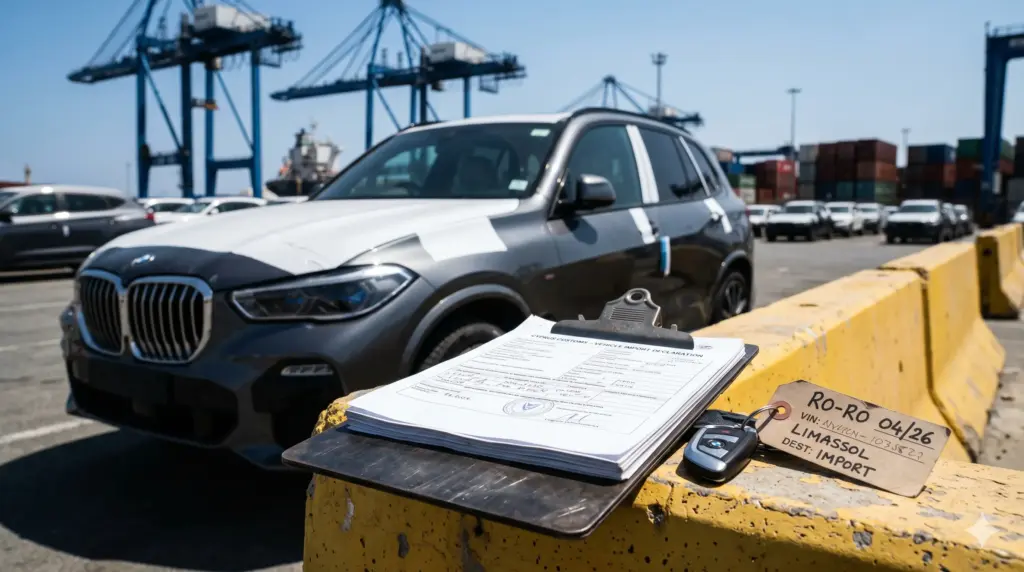
Are you planning to move permanently and do you already own a car in your home country? Then importing is an option. If you are moving to Cyprus as a permanent resident and the car is included in your list of personal belongings, it is possible to obtain an exemption from import duties. To do so, an application must be submitted to the Customs Department.
For vehicles that do not qualify for the exemption, the import costs consist of VAT (19%), registration tax based on CO₂ emissions, and any environmental levy for older vehicles.
Frequently Asked Questions
Is a non-resident allowed to buy a car in Cyprus?
Yes. Non-residents, EU citizens, and non-EU nationals can all purchase a vehicle in Cyprus. You need a valid passport, a Cypriot address (a rental contract suffices), and a local insurance policy to complete the registration.
Which documents do I need to buy a car in Cyprus?
You need a valid passport or identity document, proof of address in Cyprus, a signed purchase agreement, the vehicle registration certificate, and proof of payment. For the transfer of ownership, both parties complete the TOM 9B form and submit it to the Department for Road Transport.
Are cars expensive in Cyprus?
New cars can be slightly more expensive than in other EU countries due to import logistics and market size. Used cars are priced slightly more competitively but are still expensive, with a wide selection available at local dealers and private sellers in Limassol, Paphos, Nicosia, and Larnaca.
Do cars in Cyprus need a vehicle inspection?
Yes. All vehicles older than four years require an MOT. Cars younger than 10 years are inspected every two years; vehicles older than 10 years are inspected annually. The cost is approximately €35. A valid MOT is required before you can renew your road tax — without a valid inspection certificate, both your tax and your driving license become invalid.
Are you considering moving to Cyprus?
Buying a car is one of the first practical steps after arrival. Cyprus-Consult helps expats and entrepreneurs with the entire relocation and settlement process, from residence permits and company formation to real estate purchase and tax optimization.
Are you considering a move to the island? Book a free introductory meeting for a personal assessment of your situation.
